
📺
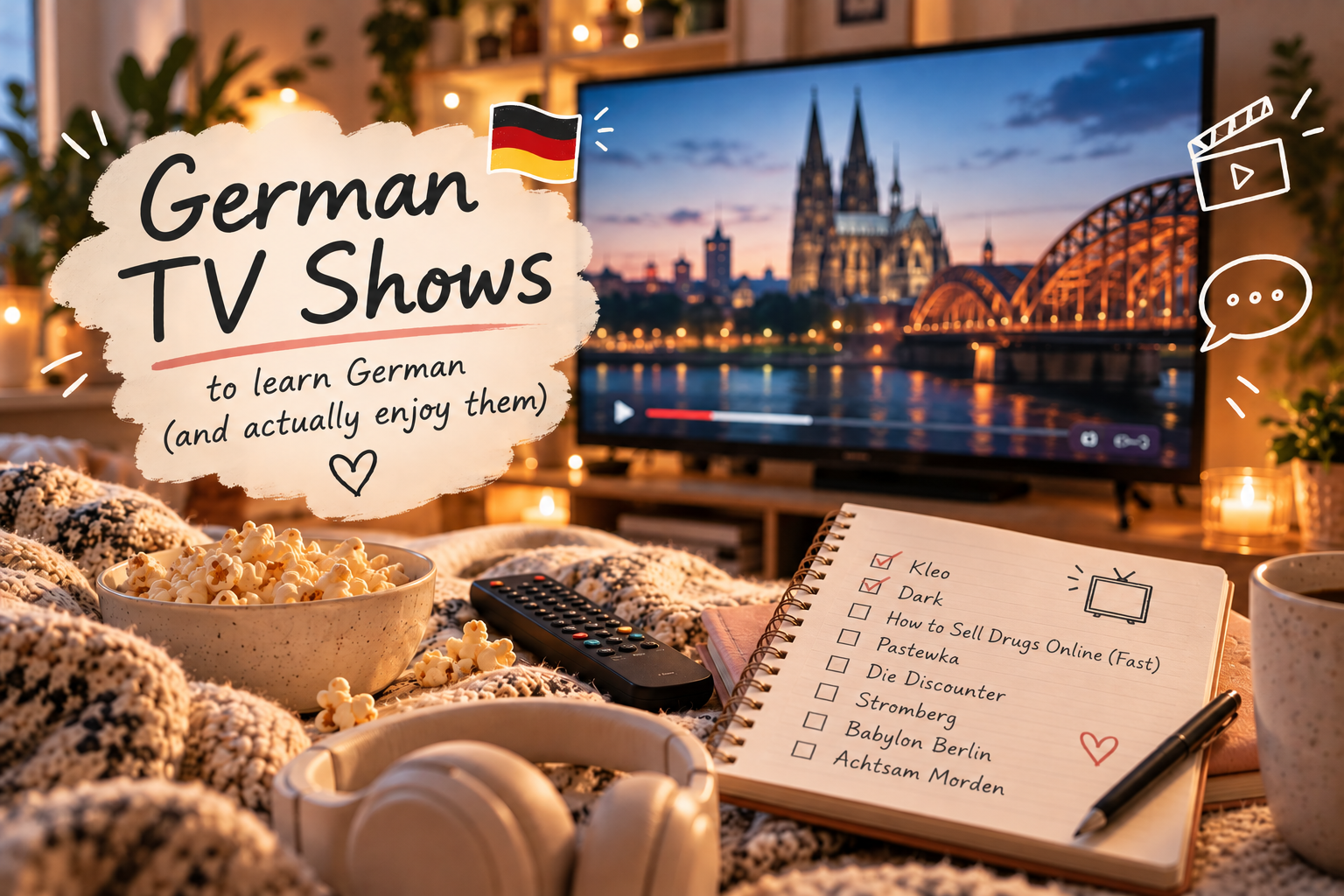
Since we have previously established that I am rather addicted to TV shows and movies, it is time for me to walk you through my watchlist of German TV shows that helped me (and are still helping) to learn German. And just super fun to watch.
Honestly speaking, for me it has always been the case that learning vocabulary from a textbook is useful, but rather boring. And hearing someone casually say „Ach, keine Ahnung,” „Das kommt darauf an,” or „Was soll das denn?” in an actual conversation makes those phrases stick, especially if it is followed by some funny or super emotional visual situations.
And here is where German TV gave me what no textbook could: everyday life expressions, hearing and learning different accents, some filler words, slang here and there, workplace convos, great real-life words to use during arguments and some jokes. And that is exactly what I have always been missing in the classroom or textbook learning. Reading historical or political texts might be fun for somebody, but not for me.
And you are also actually invested in finding out what is happening and what the main hero just said — double win here 🎯
So, let us dive in.
🎬 Netflix
Kleo (B1–B2): This one is about a former East German secret agent on a mission after the fall of the Berlin Wall. It has plenty of modern conversational German, spiced up by some Berlin expressions, and enough contextual cues for you to follow along in case the slang gets too fast and confusing.
Dark (B2–C1): A small town is shaken by mysterious events that quickly snowball into an interconnected web of even more mysterious and confusing events. It is a super interesting watch, in my opinion one of the best German TV shows, but it might break your brain once in a while, leaving you more confused than before. It has pretty clear, understandable German more suitable for higher levels — though the plot is twisty enough that you’ll occasionally forget you’re supposed to be studying. 😂
How to Sell Drugs Online (Fast) (B1–B2): A fun teen drug-dealing comedy full of youth slang and a lot of internet vocabulary. Definitely not textbook German.
Also worth a look on Netflix: Die Kaiserin (formal, historical dialogue), Türkisch für Anfänger (everyday teenage & family conversational German, but slightly outdated slang), Achtsam Morden (B1/B2, lots of conversational German mixed in with workplace/legal vocabulary and dark comic dialogues), Cassandra (household/tech vocab).
📦 Prime Video
Pastewka (B1–B2): If you like Curb Your Enthusiasm, then you should definitely check out this one. To me, it feels like its German cousin. Episodes are short, just 25 minutes, but full of conversational German across family, friends, and work. My personal favourite for a quick daily dose of awkwardness and weirdness. And it is set in Cologne.
Die Discounter (B1–B2): Mockumentary-style craziness in a discount supermarket in Hamburg. This is where you can hear everyday German conversations — colleagues joking and complaining, dealing with customers and their boss.
Stromberg (B1–B2): A German office sitcom — tons of meetings, sarcasm, corporate politics. If you were digging The Office, you definitely should check this one since they have quite a few similarities. Check it out if you want to spice up your office vocabulary while having fun watching it and occasionally feeling awkward.
Also worth a look: Maxton Hall (teen drama, lots of visual context), Perfekt Verpasst (romantic comedy), LOL: Last One Laughing Germany (all unscripted speech).
🆓 ZDF & ARD Mediathek — the free option people do not watch often
You can also check out ARD/ZDF Mediathek for completely free options to watch. It has a fairly big amount of free content. And some decent things to watch.
Babylon Berlin (B2–C1): A very fancy-produced 1920s Berlin crime drama. You will encounter vocabulary of that time — definitely not beginner German, but rather interesting, with some expressions you won’t hear in everyday situations. Worth watching for the storyline, the beautifully shown atmosphere of the 1920s, and the Berlin scenery. And what a great coincidence — the final season just dropped free on the ARD Mediathek, so it’s worth watching now before it’s removed or paid for.
Der Schwarm (B1–B2): A sci-fi thriller about mysterious ocean events — great if you like science and don’t mind specialised vocabulary.
Also worth a look: Decision Game, Oderbruch, Der Alte.
🍎 Apple TV — worth it for specific titles only
Sadly, Apple TV does not offer a wide selection of titles, but I personally enjoyed Where’s Wanda? Yeah, so far this is the only title I can recommend here.
🧠 How I use these shows to learn German
Learning through watching is one of my favourite ways to learn. It is never boring; it is always helpful to have visual aids and cues when you do not understand what is actually being said, and you are genuinely looking forward to the next episode/lesson. That is most important for me. 😂
I love learning new vocabulary, as conversations usually rely heavily on everyday language and give you tons of slang expressions, fillers, and generally good vocabulary to have in different life situations.
My favourite rule: if I do not know something, I never try to write down each and every word and each and every sentence. Perhaps 5–7 per episode, but surely not 25.
Write down just a few words or expressions you actually imagine yourself saying in normal life — like „Keine Ahnung,” „Das kommt darauf an,” or „Lass mich in Ruhe.” I would not write down how exactly coroners are examining the bodies or stuff like that.
❤️ And finally…
Don’t let watching German TV shows be another chore or to-do list for you. Always watch the first episode and see if you are willing to continue; if it is something that brings you joy and you are looking forward to the next episode. If not, ditch it. Otherwise, it will have a negative connection to studying German and will just feel like an obligation. And we are trying to make it fun!
The goal always isn’t to understand everything that is being said. It is rather to get accustomed to hearing German, recognize different accents, learn different uses of words, hear different people talking in different settings and social situations, be it a supermarket conversation or a murder investigation. It’s to make German feel a little less foreign — until one day you catch yourself thinking: “Wait. I didn’t translate that. I just understood it.”
That’s just the good way to learn. ❤️






Leave a Reply